
Carl Henrik Jonnevold (1856-1955)
Archives
-

Not Available
Biography
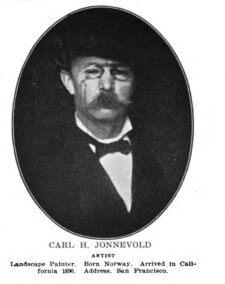 Landscape painter Carl Henrik Jonnevold was born on June 1, 1856, in Norway. He emigrated to the United States during the 1880s, arriving with modest formal training but a strong ambition to paint. He began his artistic career in the Pacific Northwest before relocating to San Francisco around 1887. There, he first established a studio at 1617 California Street, later moving to Kearny Street, where he became a fixture in the city’s growing art community.
Largely self-taught, Jonnevold cultivated his skills through direct observation of nature and tireless practice. In the early 1900s, he traveled abroad—studying in Paris and possibly Munich—where he immersed himself in the works of European masters. Deeply influenced by the Barbizon painters, he developed a tonal style characterized by realist detail balanced with a painterly, atmospheric touch.
Jonnevold earned recognition as a prolific and respected landscape and marine painter. His scenes of trees, meadows, rivers, and grazing cattle—often bathed in California’s distinct light—place him within both the Tonalist and California Impressionist traditions. His paintings are distinguished by their emphasis on mood, subtle color shifts, and a lyrical sense of place.
Although his career flourished in the late 19th and early 20th centuries, the Great Depression brought hardship. He fell into poverty and lived alone in his modest studio at 560 Kearny Street. A notorious dispute with his landlord—in which Jonnevold reportedly brandished a gun—resulted in a brief jail sentence. Following this episode, around 1930, he withdrew from the public art scene. Despite his seclusion, he continued painting into advanced age and lived nearly a century, passing away on June 9, 1955, at 99 years old.
Today, Jonnevold’s works are preserved in prominent California collections, including the California Historical Society, de Young Museum, Oakland Museum, and the Society of California Pioneers. His paintings endure as evocative records of early California’s landscape heritage, prized for their tonal beauty and historical significance.
Elaine Adams
Director
American Legacy Fine Arts
Exhibitions include:
California State Fair, 1899–1902 (awards)
Mechanics’ Institute, San Francisco, 1897
San Francisco Art Association, 1908–1912
Alaska-Yukon Exposition, Seattle, 1909 (bronze medal)
Kanst Gallery, Los Angeles, 1915
Oakland Museum, California Historical Society, and the de Young Museum