
Lorenzo Palmer Latimer (1857-1941)
Archives
-

Not Available

Biography
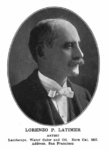
Lyrical Paintings of the Rural West
Native Califonia landscape artist and teacher Lorenzo Palmer Latimer was born on February 22, 1857 in the rugged gold rush settlement of Gold Hill, nestled in the Sierra Nevada foothills of El Dorado County. Latimer came of age in a California still forging its identity—part lawless frontier, part land of promise. His early surroundings were shaped by the dual forces of natural beauty and human ambition. Gold Hill, then one of the region’s most industrious mining districts, offered fertile soil and a temperate climate favorable for agriculture, and by the late 19th century, would supply fruit throughout the United States. Additionally, by 1869 the region became the site of the Wakamatsu Tea and Silk Farm Colony, the first permanent Japanese settlement in North America, which was established by twenty-two immigrants from Samurai families who fled the Boshin Civil War in Japan.
Formative Years: Loss, Landscape, and Legacy
Latimer’s parents were among the wave of pioneers drawn west by the lure of gold. His father, Lorenzo Dow Latimer, began his professional life as a lawyer in Chicago before seeking opportunity in California’s mines. When prospecting failed to yield success, he resumed practicing law—first in Gold Hill, then in Santa Rosa, where he gained prominence as a thoughtful and principled legal mind. His standing ultimately led to his appointment as a Superior Court Judge in San Francisco in 1869, the same year he brought twelve-year-old Lorenzo to the city.
Lorenzo's mother, Harriet Needham Latimer, passed away on February 18, 1858, when Lorenzo was just under a year old—a profound early loss that left a significant mark on his childhood. In 1865, his father married Sarah Rich, a member of a respected ranching family in Sonoma County. The family settled on a ranch near Windsor, where among the rolling hills and open skies, young Lorenzo absorbed the rhythms of rural California that would later shape his poetic landscape paintings.
Academic Discipline and Artistic Awakening
Latimer received his early education at McClure’s Military Academy in Oakland, a disciplined, all-boys institution that emphasized structure, classical learning, and character building—qualities that would later inform both his artistic sensibility and his academic style. Drawn to art from a young age, he pursued formal training at the newly established California School of Design in San Francisco (later known as the San Francisco Art Institute), which had opened in 1874 as part of the California School of Fine Arts. There, he studied under Virgil Williams (1830-1886), a Boston-born academic painter who had trained at the École des Beaux-Arts in Paris and brought with him the rigor and hierarchy of the European academic tradition. Williams was a strict classicist who emphasized the importance of draftsmanship, compositional harmony, and historical painting, and he was deeply influenced by French academic art and the teachings of Jean-Léon Gérôme (1824–1904).
Latimer thrived under this demanding curriculum and graduated in 1882, emerging with a strong foundation in drawing from life, perspective, and anatomy, as well as a reverence for the formal elements of painting. He was exposed not only to traditional academic methods but also to the early stirrings of California Impressionism through his contact with other students and visiting artists. The School of Design encouraged critical engagement and peer critique, which helped Latimer refine his aesthetic judgment and discipline. His training also included classes in decorative arts—part of a broader Arts and Crafts influence then sweeping the West—which would later inform some of his collaborative design work.
Professional Beginnings and Creative Turbulence
After graduation, Latimer opened a studio at 611 Clay Street in San Francisco, in what was then the city’s artistic epicenter. There, he formed a partnership with fellow landscape artist John A. Stanton (1857–1929) who was a professor at the San Francisco Art Institute as well as the dean of faculty. Latimer and Stanton exhibited their work and accepted decorative commissions—blending the fine and applied arts in a manner consistent with the ideals of the Arts and Crafts movement. Yet despite this promising start, Latimer’s career soon veered off course.
Lorenzo Latimer became entangled in the magnetic orbit of French-born artist Jules Tavernier (1844–1889), a virtuoso colorist and outspoken bohemian whose circle was as notorious for its artistic daring as for its indulgent lifestyle, particularly heavy drinking. Tavernier, who had trained in engraving and painting in Paris before settling in California, championed absolute freedom in artistic expression—unencumbered by financial constraint or social convention. “An artist,” he was reputed to say, “should not be bothered with bills or sobriety.” Under Tavernier’s influence, Latimer gradually drifted from the disciplined habits instilled during his academic training. By many accounts, the 1880s marked a fallow period in his career. Though he remained active in creative circles, his artistic output diminished, and critics would later regard this chapter as one of unrealized promise rather than lasting achievement.
A Return to Discipline
By the early 1890s, Latimer began to distance himself from the chaotic bohemianism of the Tavernier circle and reestablished the discipline that had once shaped his formative training. Whether through personal resolve or practical necessity, he adopted a more sober and structured approach to his life and work. He resumed painting with greater consistency and increasingly sought out California’s natural beauty for inspiration, particularly the remote valleys, lakes, and forests of the northern part of the state.
It was during this period that Latimer also discovered his passion for teaching—a role that would ultimately define much of his legacy. He began to offer private instruction in San Francisco and later took on positions with various regional art societies. His reputation as a patient and insightful teacher grew, and he became known for his ability to draw out individual expression in his students while still emphasizing strong foundational technique. His instruction often focused on plein air painting, urging students to engage directly with the landscape and capture the fleeting qualities of light and atmosphere.
The Latimer Art Club
Latimer’s dedication to teaching found its most enduring expression in 1916, when he began offering painting classes in Reno, Nevada. These classes culminated in the establishment of the Latimer Art Club in 1921, founded by his students to foster a community for artists in a region where formal art education was scarce. The club became a vital gathering place for aspiring artists across northern Nevada. Latimer’s students—many of whom would go on to become respected regional painters—remembered him as a quiet yet exacting instructor who emphasized discipline, careful observation, and emotional restraint in composition. Founded with the support of local students and patrons, the Latimer Art Club quickly became a central hub for artistic growth and played a formative role in shaping the early cultural identity of the state.
Latimer’s summer excursions to Lake Tahoe, the Carson Valley, and California’s redwood forests near Mendocino became cherished annual traditions. These serene and majestic landscapes, where he not only painted but also led plein air workshops, resonated deeply with his artistic temperament. They offered the unspoiled sense of place he so often sought to preserve in his work.
Though he never pursued notoriety, Latimer’s quiet leadership, aesthetic sensitivity, and steadfast commitment to traditional values in art education earned him enduring respect in the evolving artistic landscape of the American West. His work—rooted in direct observation and a profound reverence for nature—embodies a distinctly Californian lyricism, shaped by early hardship, rigorous academic training, and a lifelong intimacy with the land. His legacy continues to inspire generations of artists who share his devotion to the natural world.
Personal Life
Despite his prominent role in the artistic and educational circles of California and Nevada, Lorenzo Palmer Latimer led a quiet and private life. In 1893, at the age of 36, he married Jennie Phelps, thereby linking himself to the distinguished Phelps family lineage. Their union was grounded in mutual support, providing Latimer with the stability necessary for his sustained creative and pedagogical work. In 1896, they welcomed their only child, Lorenzo Phelps Latimer Jr., who was raised in the Bay Area amid a household that valued both intellectual pursuit and aesthetic refinement. The younger Latimer inherited his father’s appreciation for watercolor and the natural world, becoming an amateur painter in his own right. He ultimately chose a scholarly path, serving as a professor of agriculture at the University of New Hampshire in Durham, thus continuing the family tradition of dedication to education and the land.
Though Jennie Phelps Latimer maintained a low public profile, her presence offered the kind of stability that underpinned her husband’s long and disciplined career. Their household, set within reach of San Francisco’s vibrant art scene, provided Latimer with the grounding necessary to balance his roles as teacher, painter, and mentor to a generation of California and Nevada artists.
In his later years, Latimer settled in Berkeley, California, where he remained active as both a teacher and painter well into old age. Though the art world around him was increasingly captivated by abstraction and modernist experiments, Latimer held fast to his belief in direct observation and the poetic truth of the natural world. He passed away on January 14, 1941 at the age of 84, leaving behind not only a body of evocative, regionally grounded landscape paintings, but also a legacy of mentorship and artistic community-building that endured through generations, not only in Reno and San Francisco, but across the broader Western art movement that would grow in the 20th century.
Posthumous Recognition and Palmer’s Legacy
In recent decades, Lorenzo Palmer Latimer’s artistic legacy has undergone renewed scholarly attention, as historians and collectors increasingly recognize his pivotal role in shaping the visual culture of early California and Nevada. Today, His work is now represented in public and private collections throughout the region. Institutions dedicated to Western and plein air art have begun to reappraise Latimer’s contributions, acknowledging him not only as a painter of poetic landscapes but also as a formative influence in the artistic life of the American West.
In honor of the 100th anniversary of the Latimer Art Club, the Nevada Museum of Art mounted a major retrospective exhibition in July 2021 titled The Latimer School: Lorenzo Latimer and the Latimer Art Club. Accompanied by a comprehensive 375-page hardcover publication, the seven-month exhibition offered the most extensive exploration to date of Latimer’s impact as both artist and educator.
Latimer’s legacy endures through the ongoing activities of the Latimer Art Club, the accomplishments of his students and artistic descendants, and the lasting resonance of the luminous, contemplative landscapes he spent a lifetime capturing—images that continue to reflect the spirit and beauty of the West he so loved.
Elaine Adams
Director
American Legacy Fine Arts
Research Sources:
California State Library, Biographical Files – “Lorenzo Palmer Latimer” entry. Sacramento, CA.
Find A Grave – Memorial pages for Lorenzo Palmer Latimer and Harriet Needham Latimer. www.findagrave.com
El Dorado County Historical Society – “Gold Hill and Surrounding Mining Districts.” www.edcgov.us
Wikipedia – “Gold Hill, El Dorado County, California.” https://en.wikipedia.org/wiki/Gold_Hill,_El_Dorado_County,_California
Wikipedia – “Wakamatsu Tea and Silk Farm Colony.” https://en.wikipedia.org/wiki/Wakamatsu_Tea_and_Silk_Farm_Colony
Historic American Landscapes Survey – “Wakamatsu Tea and Silk Farm Colony.” National Park Service, U.S. Department of the Interior.
The Latimer Art Club, Reno, Nevada – Historical overview. www.latimerartclub.com
“Artful Lives: California Art Club at 100” by Molly Siple and Elaine Adams. California Art Club / Skira Rizzoli, 2010.
California Art Research, Vol. 7, WPA Project, compiled by Gene Hailey, 1936–1937. (Biography of Lorenzo P. Latimer.)
Santa Rosa and Sonoma County Historical Archives – Family records on Lorenzo Dow Latimer and Sarah Rich.
“Pioneering Landscapes: The Life and Work of Lorenzo P. Latimer” (unpublished research notes), held in the archives of the Nevada Museum of Art.
U.S. Census Records (1860, 1870, 1880) – California and Illinois listings for Latimer family members. National Archives and Records Administration.
“Gold Hill District,” California Geological Survey Bulletin, Vol. 193, El Dorado County, California, 1956.
United States Federal Census, 1860 and 1870; records for Lorenzo D. Latimer and family.
“Harriet Needham Latimer Death Record,” El Dorado County Vital Records, 1858.
Sonoma County Historical Society, Biographical Sketches of Pioneer Families, 1902.
“Judge Lorenzo D. Latimer,” The Daily Alta California, August 3, 1869, p. 2.
“McClure’s Military Academy,” The Oakland Tribune, February 12, 1875.
San Francisco Art Institute Archives, “History of the California School of Design,” accessed 2024.
Harrison, Alfred C. Jr. Jules Tavernier: Artist and Adventurer, Petersen Gallery, 1990.
Hughes, Edan Milton. Artists in California, 1786–1940, 3rd ed., Crocker Art Museum, 2002.
"John A. Stanton (1857–1929)," California Art Club Archives.
“Latimer’s Early Work Exhibited,” San Francisco Call, March 28, 1885.
FamilySearch.org, “Lorenzo Palmer Latimer – Death Certificate,” California Death Index, 1941.
Nevada Museum of Art, Latimer Art Club Centennial Exhibition Catalog, 2021.
Latimer Art Club Records, University of Nevada, Reno Special Collections.
Interview with Karen Burns, curator, Nevada Historical Society, April 2023.